

Removing Solids from Separators on an FPSO
When solids begin to accumulate in a production separator, operators face an urgent challenge. Sand accumulation is problematic because it reduces the separator's capacity, hinders proper fluid separation, and can damage downstream equipment. The immediate response is typically to reduce production flow below the lift rate of particles. But the ultimate result will then be a build-up of solids in the tubing, resulting in the well becoming shut-in, and losing valuable production.
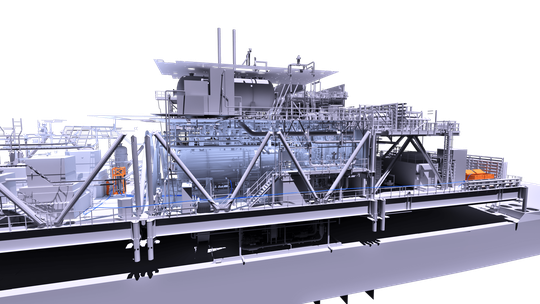
On offshore installations, like FPSOs where space is limited, traditional desanding solutions can be difficult to deploy due to the size of the equipment required. The SingleFlow unit was developed by FourPhase to address this exact scenario: where solids removal is necessary, but permanent infrastructure doesn’t exist. In addition, space or time constraints would render standard solutions impractical.
On offshore installations, like FPSOs where space is limited, traditional desanding solutions can be difficult to deploy due to the size of the equipment required. The SingleFlow unit was developed by FourPhase to address this exact scenario: where solids removal is necessary, but permanent infrastructure doesn’t exist. In addition, space or time constraints would render standard solutions impractical.
What Makes the SingleFlow Jetting Unit Ideal for FPSOs?
A traditional desanding unit can measure up to 4x8 meters in size and demand significant deck space, structural support, and rig-up time. This often makes them incompatible with FPSO vessels.
In 2023, Aker BP and FourPhase addressed this challenge head-on with a jetting operation on the Alvheim FPSO. The SingleFlow Jetting Unit was developed and engineered specifically for an FPSO, measuring just 1.1 x 1.1 in its compact, modular configuration. Using FourPhase’s stand-alone SingleFlow jetting unit, solids were safely removed from a production separator without sand reaching the closed drain or export systems. Additionally, only one offshore operator was required, thereby reducing the number of personnel on board (POB).
During the Alvheim operation, the jetting unit was deployed horizontally to fit the limited deck space on the FPSO. This small-footprint approach proved ideal for Alvheim, where permanent jetting systems weren’t installed and no accurate estimate of solids volume was available.
Key features of the solution include:
• Modular design that fits within tight spaces
• Manual operation - no automation required
• Only one person needed offshore (1 POB)
• Delivered on a rental basis, avoiding CAPEX
• No confined space entry
• Zero sand to the export line
The operation was conducted as part of a well test campaign, where the production separator was expected to receive solids. Instead of risking downstream contamination, solids were removed offline using the jetting unit, with waste directed to skips for onshore disposal.
To improve efficiency, the unit was paired with an ejector to boost supply pressure, increasing jetting performance. FourPhase also deployed its real-time solids weighing system, which provided an accurate measurement of removed sand (166 kg) and supported informed decision-making for ongoing production optimisation.
The entire project, from mobilisation to demobilisation, was completed in seven days, with zero HSE incidents.
In 2023, Aker BP and FourPhase addressed this challenge head-on with a jetting operation on the Alvheim FPSO. The SingleFlow Jetting Unit was developed and engineered specifically for an FPSO, measuring just 1.1 x 1.1 in its compact, modular configuration. Using FourPhase’s stand-alone SingleFlow jetting unit, solids were safely removed from a production separator without sand reaching the closed drain or export systems. Additionally, only one offshore operator was required, thereby reducing the number of personnel on board (POB).
During the Alvheim operation, the jetting unit was deployed horizontally to fit the limited deck space on the FPSO. This small-footprint approach proved ideal for Alvheim, where permanent jetting systems weren’t installed and no accurate estimate of solids volume was available.
Key features of the solution include:
• Modular design that fits within tight spaces
• Manual operation - no automation required
• Only one person needed offshore (1 POB)
• Delivered on a rental basis, avoiding CAPEX
• No confined space entry
• Zero sand to the export line
The operation was conducted as part of a well test campaign, where the production separator was expected to receive solids. Instead of risking downstream contamination, solids were removed offline using the jetting unit, with waste directed to skips for onshore disposal.
To improve efficiency, the unit was paired with an ejector to boost supply pressure, increasing jetting performance. FourPhase also deployed its real-time solids weighing system, which provided an accurate measurement of removed sand (166 kg) and supported informed decision-making for ongoing production optimisation.
The entire project, from mobilisation to demobilisation, was completed in seven days, with zero HSE incidents.
“We trusted FourPhase with the solids management scope and are very happy with the execution their team delivered both on and offshore.”
— Pål Hapnes, Asset Production Manager - AkerBP, Alvheim
— Pål Hapnes, Asset Production Manager - AkerBP, Alvheim
Why Is Jetting a Critical Capability for Late-Life Fields?
Solids become a problem when you’re unprepared, particularly on late-life assets. The infrastructure on these assets may be incomplete, and sand production can spike unpredictably. In these scenarios, quick mobilisation and simple deployment can make the difference between a successful intervention and significant production loss.
The SingleFlow jetting unit provides a cost-effective and efficient alternative to traditional desanding systems. It is small and modular enough to be used in remote and space-constrained installations. It represents a shift toward more agile solids management without compromising safety or performance.
The SingleFlow jetting unit provides a cost-effective and efficient alternative to traditional desanding systems. It is small and modular enough to be used in remote and space-constrained installations. It represents a shift toward more agile solids management without compromising safety or performance.
How Does This Compare to Online Jetting Operations?
FourPhase also has a strong track record of online jetting projects, including:
• Maintaining $17M in production during online separator jetting
• Protecting $25M in production with online desanding
While those examples demonstrate the effectiveness of online operations, the Alvheim case highlights that traditional jetting can also be executed with speed, safety, and precision. Especially when a flexible, modular system like SingleFlow is used.
As more operators look to extend the life of fields while managing risk and cost, solutions like the SingleFlow jetting unit are likely to play a greater role. By combining mobility, modularity, and measurable results, these systems offer a quick and easy solution to a long-standing challenge: how to deal with unexpected sand on your assets.
Even Solsvik, Project Manager at Fourphase, commented: “We’re proud to have once again assisted Aker BP with optimising their operations.”
• Maintaining $17M in production during online separator jetting
• Protecting $25M in production with online desanding
While those examples demonstrate the effectiveness of online operations, the Alvheim case highlights that traditional jetting can also be executed with speed, safety, and precision. Especially when a flexible, modular system like SingleFlow is used.
As more operators look to extend the life of fields while managing risk and cost, solutions like the SingleFlow jetting unit are likely to play a greater role. By combining mobility, modularity, and measurable results, these systems offer a quick and easy solution to a long-standing challenge: how to deal with unexpected sand on your assets.
Even Solsvik, Project Manager at Fourphase, commented: “We’re proud to have once again assisted Aker BP with optimising their operations.”
Get in touch