

Utilising Light Well Intervention (LWI) Vessels for Solids Management
Light Well Intervention (LWI) vessels are increasingly used as an alternative to traditional rig-based interventions, offering a more cost, and time, efficient option. When integrated with Coiled Tubing (CT) operations, LWI’s can facilitate effective cleanout of solids accumulation in production wells, restoring flow and mitigating production losses. Thus, providing a viable alternative to full rig mobilisation. But LWI operations are subject to several constraints, including limited deck footprint, lower Personnel on Board (POB) allowances, and strict requirements for equipment certification and weight.
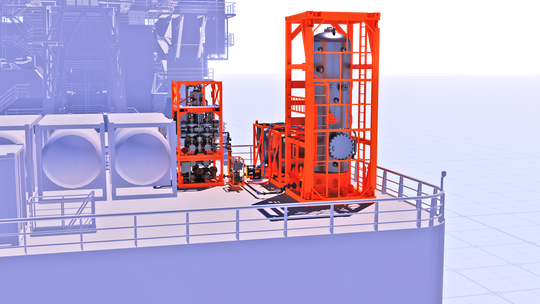
To address these constraints, FourPhase developed the DualFlow desander: a compact, modular solution engineered for handling production flowback and CT operations where space is limited. The unit measures only 2 x 2 metres and is designed for rapid mobilisation and integration. Fully certified for offshore use, the DualFlow system provides high-efficiency solids separation while maintaining a low operational footprint, supporting safe and reliable well cleanout activities, also from vessel-based interventions.
To address these constraints, FourPhase developed the DualFlow desander: a compact, modular solution engineered for handling production flowback and CT operations where space is limited. The unit measures only 2 x 2 metres and is designed for rapid mobilisation and integration. Fully certified for offshore use, the DualFlow system provides high-efficiency solids separation while maintaining a low operational footprint, supporting safe and reliable well cleanout activities, also from vessel-based interventions.
Case Study: First Monohull Riser-Based CT Intervention on the NCS
A North Sea operator needed to flow two separate wells using coiled tubing from a monohull LWI vessel. Both wells were heavily obstructed with sand, scale and debris. Effective solids management was crucial to ensure a safe flowback and a successful intervention.
Given the limited space onboard, the operator sought a solution that could be rigged up onshore and deployed quickly offshore. Working in collaboration with a team of service companies, the DualFlow was installed on a pre-assembled quick interface frame. This was a modular structure incorporating the desander, pipework, and all required connections. It was lifted onboard as a single unit, significantly reducing vessel time at shore and installation complexity.
In addition to operating from a light intervention vessel, equipment must meet rigorous offshore standards. The FourPhase DualFlow desander is qualified under DNV OS-E101 for Mobile Offshore Drilling Units (MODUs). FourPhase’s engineers performed a sea fastening analysis to ensure we were within the tolerances of the standard. This meant that the DualFlow could be safely integrated into the vessel layout.
The unit was operated remotely from a shared control container, with solids-rich flowback routed through the desander when required. This design not only supported efficient operations but also reduced POB and manual handling. This lowered risk and exposure time.
During the 10-week campaign:
• 7,283 kg of solids were safely separated and removed
• Solids removal averaged 22 kg/hr
• The unit required a 2-man crew and just a 2x2 metre footprint
The result was a repeatable solution suitable for campaigns across the NCS, Australia and other offshore markets. Solids accumulation continues to be a leading cause of deferred production and well shutdown, and knowing that LWI vessels and coiled tubing is an option to unlock well access can be a game changer for operators.
Given the limited space onboard, the operator sought a solution that could be rigged up onshore and deployed quickly offshore. Working in collaboration with a team of service companies, the DualFlow was installed on a pre-assembled quick interface frame. This was a modular structure incorporating the desander, pipework, and all required connections. It was lifted onboard as a single unit, significantly reducing vessel time at shore and installation complexity.
In addition to operating from a light intervention vessel, equipment must meet rigorous offshore standards. The FourPhase DualFlow desander is qualified under DNV OS-E101 for Mobile Offshore Drilling Units (MODUs). FourPhase’s engineers performed a sea fastening analysis to ensure we were within the tolerances of the standard. This meant that the DualFlow could be safely integrated into the vessel layout.
The unit was operated remotely from a shared control container, with solids-rich flowback routed through the desander when required. This design not only supported efficient operations but also reduced POB and manual handling. This lowered risk and exposure time.
During the 10-week campaign:
• 7,283 kg of solids were safely separated and removed
• Solids removal averaged 22 kg/hr
• The unit required a 2-man crew and just a 2x2 metre footprint
The result was a repeatable solution suitable for campaigns across the NCS, Australia and other offshore markets. Solids accumulation continues to be a leading cause of deferred production and well shutdown, and knowing that LWI vessels and coiled tubing is an option to unlock well access can be a game changer for operators.
Reducing Operational Risk and Cost Through Vessel-Based Sand Management
Coiled Tubing (CT) interventions conducted from Light Well Intervention (LWI) vessels remain a key method for maintaining well access and extending asset life. Effective solids management during these operations is essential to ensure flow assurance, reduce intervention frequency, and maintain production efficiency.
The FourPhase DualFlow desander is engineered for integration with vessel-based CT campaigns, providing a compact, certified solution with a minimal footprint. Its design supports rapid mobilisation and deployment, while reducing the need for additional personnel or deck modifications.
By enabling efficient separation of produced solids at surface, the DualFlow contributes to safer, more controlled interventions. Whether as part of planned maintenance or reactive cleanout operations. The result is reduced non-productive time (NPT), lower environmental exposure, and a measurable reduction in operational cost and complexity.
The FourPhase DualFlow desander is engineered for integration with vessel-based CT campaigns, providing a compact, certified solution with a minimal footprint. Its design supports rapid mobilisation and deployment, while reducing the need for additional personnel or deck modifications.
By enabling efficient separation of produced solids at surface, the DualFlow contributes to safer, more controlled interventions. Whether as part of planned maintenance or reactive cleanout operations. The result is reduced non-productive time (NPT), lower environmental exposure, and a measurable reduction in operational cost and complexity.
Get in touch