

Adding value and reducing risk for Equinor
Norwegian North Sea, 2024
Creating added value and increased revenue for clients is what drives us at FourPhase. When we are also able to reduce risk, we are even happier. Starting in 2018, one of our longest operations for Equinor does exactly that.
By Olof Nilsson, Marketing Manager, FourPhase
At the Kvitebjørn field in the Norwegian North Sea, operator Equinor was having challenges with their water injection pumps in 2018. The pumps were crucial as they were reinjecting produced water from a separator serving several wells back into the formation. However, the pumps kept malfunctioning, and pump downtime was a severe risk for extended production delays.
By Olof Nilsson, Marketing Manager, FourPhase
At the Kvitebjørn field in the Norwegian North Sea, operator Equinor was having challenges with their water injection pumps in 2018. The pumps were crucial as they were reinjecting produced water from a separator serving several wells back into the formation. However, the pumps kept malfunctioning, and pump downtime was a severe risk for extended production delays.
Finding the root cause
Troubleshooting the issue, the pump suppliers insisted that pumps were malfunctioning due to sand in the produced water, causing corrosion damage in the pumps. However, installed sand detectors did not indicate sand production.
As Equinor aimed for increasing production on the field, and needed additional pumping capacity with stable uptime, they opted for a trial period with a FourPhase DualFlow desander. The aim of the trial was to confirm and separate if sand was present and, if so, quantify the sand.
The trial showed large amounts of sand in the produced water removed by the desander, proving to all parties that sand was causing the pump malfunctions and that desanding was necessary. Converting the trial period into a long-term desanding operation was the natural next step, eliminating the pump issues. The DualFlow desander was installed and can remove 99,8 % of solids down to 20 microns under optimal conditions. As of today, FourPhase has removed more than 25t of solids on Kvitebjørn alone.
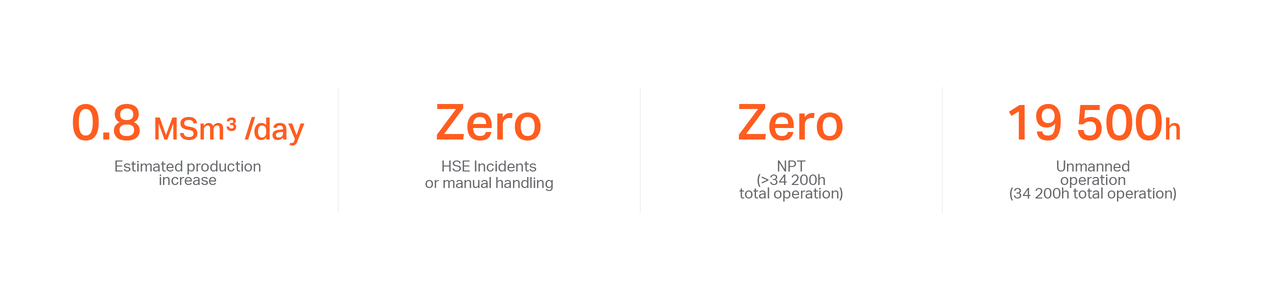
The operation continues to this date, facilitating an 0.8 MSm3/day production increase and an additional $3 M/month revenue hike compared to the previous production level.
As Equinor aimed for increasing production on the field, and needed additional pumping capacity with stable uptime, they opted for a trial period with a FourPhase DualFlow desander. The aim of the trial was to confirm and separate if sand was present and, if so, quantify the sand.
The trial showed large amounts of sand in the produced water removed by the desander, proving to all parties that sand was causing the pump malfunctions and that desanding was necessary. Converting the trial period into a long-term desanding operation was the natural next step, eliminating the pump issues. The DualFlow desander was installed and can remove 99,8 % of solids down to 20 microns under optimal conditions. As of today, FourPhase has removed more than 25t of solids on Kvitebjørn alone.
The operation continues to this date, facilitating an 0.8 MSm3/day production increase and an additional $3 M/month revenue hike compared to the previous production level.
Changing the criteria
As production from several wells depended on the reinjection pumps, Equinor regarded the consequences of downtime as a large potential risk for reaching their production goals. Removing the root cause of the malfunctions thus contributed greatly to reducing risk for Equinor.
Learnings from desanding at Kvitebjørn have also changed Equinor’s steering criteria practice for low flowrate wells at Kvitebjørn. As of December 2018, there was a set maximum Acceptable Sand Rate (ASR) that wells should stay under to avoid filling up the production separator with sand. But Equinor engineers saw the potential to shift from well steering based on sand rates to using erosion rates instead. Since 2018, all low-flow rate wells have been steered according to erosion rates, allowing increased production without choking back the well.
Currently, our small-footprint de-sander is tucked away in a well slot, doing its job monitored by the personnel already on board. Based on experience with the Kvitebjørn wells, and in collaboration with Equinor, we have reduced our fortnightly service interval to a monthly service to reduce personnel on board. We have not had a single hour of unplanned downtime on the desander during the past 5 years.
Learnings from desanding at Kvitebjørn have also changed Equinor’s steering criteria practice for low flowrate wells at Kvitebjørn. As of December 2018, there was a set maximum Acceptable Sand Rate (ASR) that wells should stay under to avoid filling up the production separator with sand. But Equinor engineers saw the potential to shift from well steering based on sand rates to using erosion rates instead. Since 2018, all low-flow rate wells have been steered according to erosion rates, allowing increased production without choking back the well.
Currently, our small-footprint de-sander is tucked away in a well slot, doing its job monitored by the personnel already on board. Based on experience with the Kvitebjørn wells, and in collaboration with Equinor, we have reduced our fortnightly service interval to a monthly service to reduce personnel on board. We have not had a single hour of unplanned downtime on the desander during the past 5 years.